
Level 2 · Modeling a real institution
Public Framework Practitioner
The Practitioner certification confirms that you can apply Public Framework to a specific institution and public service: from analysing the legal basis to a complete, consistent and traceable model that a vendor can implement.
At a glance
- Prerequisites
- Foundation certificate
- Course
- 3 days, 21 hours
- Exam
- 4 scenarios, 150 min
- Pass mark
- 50%
- Validity
- 3 years
Upcoming sessions
No sessions have been announced yet. Subscribe to the newsletter to hear first when registration opens.
Subscribe to the newsletterWhat you will be able to do
Once certified, you will be able to:
- Analyse legislation and extract the relevant competences, obligations and deadlines.
- Model an institution’s structure and how competences are assigned to roles.
- Design a public service from the life event to the delivered outcome.
- Describe the processes and information objects that support the service.
- Check a model against the consistency rules and keep it traceable down to the system.
- Decide how the model is versioned, reviewed and governed over time.
Who it is for
For those who will actually model: business and IT analysts, architects, lawyers involved in redesigning procedures, digitalization project leads and consultants.
Syllabus
Modules follow the order in which they are taught on the course.
- Read in the documentation: From legal basis to competence
From legal basis to competence
Reading legislation in a structured way and turning it into elements of the legal layer.
- Legal analysis
- Competences
- Obligations and deadlines
- Read in the documentation: Modeling the institution
Modeling the institution
Structures, roles and assignment of competences, including institutions with territorial branches.
- Structures
- Roles
- Delegation
- Read in the documentation: Designing the public service
Designing the public service
The service as the beneficiary sees it: life event, channels, conditions and outcome.
- Life event
- Channels
- Outcome
- Read in the documentation: Processes and information
Processes and information
The internal workflow and the documents, data and registers it relies on.
- Processes
- Administrative objects
- Registers
- Read in the documentation: Consistency and traceability
Consistency and traceability
Applying the consistency rules and keeping a verifiable link between law, service and information system.
- Consistency rules
- Traceability
- Technology layer
Model governance and the case study
Versioning, responsibilities and review. The module ends with a team modeling a real service end to end.
- Versioning
- Responsibilities
- Case study
The exam
A scenario-based exam: each scenario describes an institution and a service, and the questions ask you to analyse, choose and justify modeling decisions.
- Format
- 4 scenarios of 20 items each, 80 marks in total
- Duration
- 150 minutes (190 for candidates not taking it in their native language)
- Pass mark
- 40 marks out of 80 (50%)
- Materials
- The specification and the metamodel, printed or as PDF
- Delivery
- Proctored online, or in person after the course
Sample question
Scenario
A city hall wants to offer urban planning certificates online. The IT team has already started designing the web form, based on the paper application.
According to the framework, what is the recommended step before design continues?
- Publish the form quickly and collect feedback from citizens
- Model the procedure starting from the legal basis, identifying the competences and administrative objects involved
- Choose the technology platform the form will run on
- Scan the archive of previously issued certificates
Show the answer
Correct answer: B
The principle “Modeling comes before implementation”: the form is only a channel. Without a model of the procedure and its administrative objects, digitalization copies paper instead of rethinking the service.
The certificate
Public Framework Practitioner
- Personal digital certificate with a unique number
- Valid for 3 years from passing
- Renewal by exam or portfolio of models
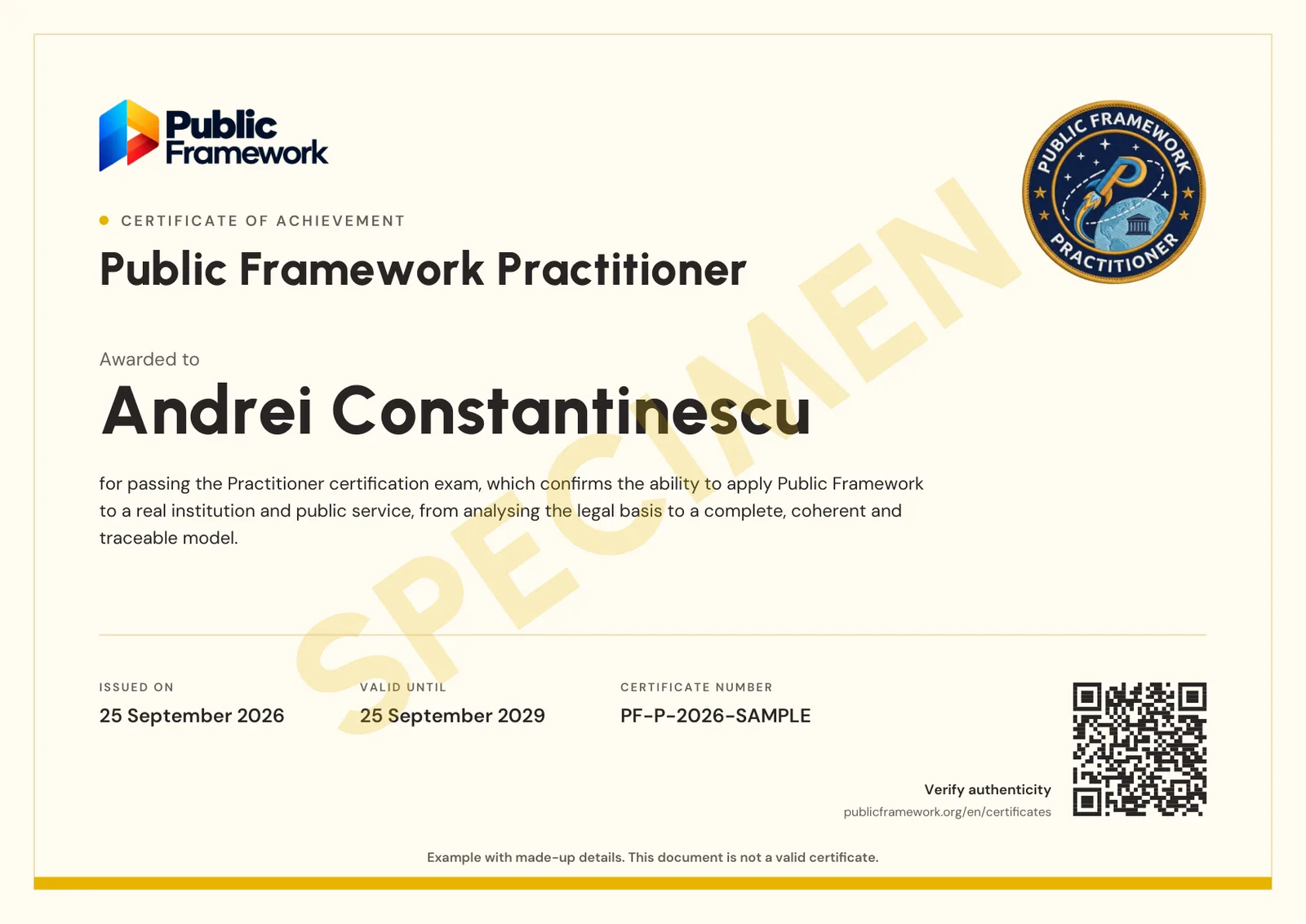
Every certificate has a unique number and a QR code that opens its verification page. The example below uses a made-up name and number.
 Level 1Public Framework FoundationStart with the fundamentals
Dedicated training for your institution
Institutions that sign the Memorandum of Collaboration can run Foundation and Practitioner sessions for their own staff. We announce the calendar of open sessions in the newsletter.